Frog Anatomy part 1 Body parts
External Anatomy
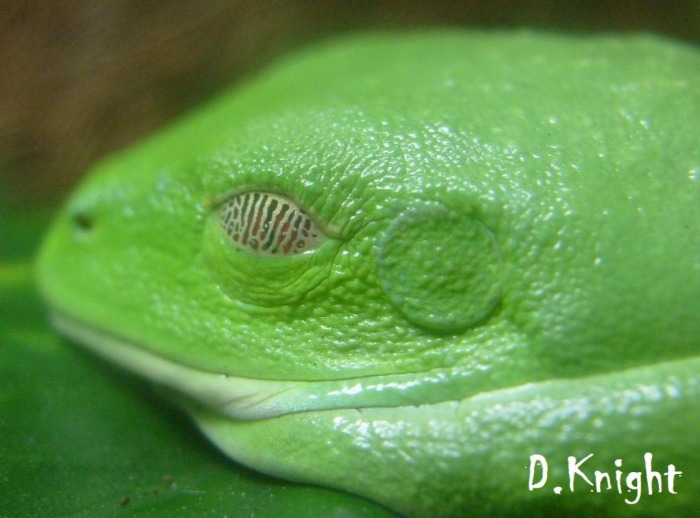
Pupil - The opening through which light enters an eye.
Iris - The colored part of the eye which forms and regulates the size of the pupil.
Cornea - The transparent anterior part of the external layer of the eye (transparent outer covering of the eye).
Nictitating Membrane - A transparent part of a frog’s lower eyelid that moves over the eye to clean it and protect it.
Lens - The transparent structure within an eye that focuses light rays.
External nares or nostrils - Anterior openings for the entry or exit of air.
Tympanic Membrane - The eardrum - receives sound waves
Flexors - Muscles which contract to move a part toward the body.
Extensors - Muscles which contract to move a part away from the body.
Mucous Glands - Structures in the skin of a frog that secrete mucous which keeps the skin moist.
Poison Glands - Structures in the skin of the frog which secrete a whitish fluid that is highly irritating to enemies.
Epidermis - The outer layer of the skin.
Dermis - The inner layer of skin which contains blood vessels and pigment cells.
Glottis - The opening from the mouth into the respiratory system.
Larynx - The voice box (contains vocal cords).
Bronchi - The short tubes of a frog’s breathing system that leads from the larynx to the lungs.
Lungs - Exchange point where CO2 leaves and O2 enters the blood
Alveoli - Air sacs in the lungs where the movement of gases occurs.
Red Blood Cells - Blood cells which carry O2 and CO2.
Hemoglobin - The red pigment in red blood cells which combine with and carry gases.
Cold-blooded - Condition or designation of an animal’s body temperature being the same as the external temperature.
Hibernation - A state of dormancy during which life processes and activities are greatly slowed and reduced.
Arteries - Thick-walled blood vessels that carry blood under high pressure away from the heart.
Arterioles - Small arteries which branch out into capillaries.
Capillaries - Smallest blood vessels with thinnest walls through which substances move into and out of the blood.
Venules - Small blood vessels which carry blood away from capillaries.
Veins - Thin walled blood vessels that carry blood under low pressure to the heart.
Neurotransmitters - Chemical substances produced by an animal that influence parts of the body (“chemical messengers”).
Tongue - Muscular structure attached to the front of the mouth which is extended to catch insects (its food).
Maxilla - The upper jaw.
Maxillary Teeth - Sharp teeth in the maxilla of a frogs mouth that function in holding captured prey.
Mandible - The lower jaw.
Vomerine Teeth - Small projections in the top of a frog’s mouth that function in holding and captured prey.
Eustachian tube openings - Openings in the mouth that lead to tubes that connect to the middle ear to equalize air pressure.
Pupil - The opening through which light enters an eye.
Iris - The colored part of the eye which forms and regulates the size of the pupil.
Cornea - The transparent anterior part of the external layer of the eye (transparent outer covering of the eye).
Nictitating Membrane - A transparent part of a frog’s lower eyelid that moves over the eye to clean it and protect it.
Lens - The transparent structure within an eye that focuses light rays.
External nares or nostrils - Anterior openings for the entry or exit of air.
Tympanic Membrane - The eardrum - receives sound waves
Flexors - Muscles which contract to move a part toward the body.
Extensors - Muscles which contract to move a part away from the body.
Mucous Glands - Structures in the skin of a frog that secrete mucous which keeps the skin moist.
Poison Glands - Structures in the skin of the frog which secrete a whitish fluid that is highly irritating to enemies.
Epidermis - The outer layer of the skin.
Dermis - The inner layer of skin which contains blood vessels and pigment cells.
Glottis - The opening from the mouth into the respiratory system.
Larynx - The voice box (contains vocal cords).
Bronchi - The short tubes of a frog’s breathing system that leads from the larynx to the lungs.
Lungs - Exchange point where CO2 leaves and O2 enters the blood
Alveoli - Air sacs in the lungs where the movement of gases occurs.
Red Blood Cells - Blood cells which carry O2 and CO2.
Hemoglobin - The red pigment in red blood cells which combine with and carry gases.
Cold-blooded - Condition or designation of an animal’s body temperature being the same as the external temperature.
Hibernation - A state of dormancy during which life processes and activities are greatly slowed and reduced.
Arteries - Thick-walled blood vessels that carry blood under high pressure away from the heart.
Arterioles - Small arteries which branch out into capillaries.
Capillaries - Smallest blood vessels with thinnest walls through which substances move into and out of the blood.
Venules - Small blood vessels which carry blood away from capillaries.
Veins - Thin walled blood vessels that carry blood under low pressure to the heart.
Neurotransmitters - Chemical substances produced by an animal that influence parts of the body (“chemical messengers”).
Tongue - Muscular structure attached to the front of the mouth which is extended to catch insects (its food).
Maxilla - The upper jaw.
Maxillary Teeth - Sharp teeth in the maxilla of a frogs mouth that function in holding captured prey.
Mandible - The lower jaw.
Vomerine Teeth - Small projections in the top of a frog’s mouth that function in holding and captured prey.
Eustachian tube openings - Openings in the mouth that lead to tubes that connect to the middle ear to equalize air pressure.
Internal Anatomy
Skeletal muscles - Muscles of the body which control voluntary movements.
Tendons - Strands of tissue which attach skeletal muscles to bones.
Smooth Muscle - Muscle tissue of inner organs which control involuntary muscles.
Gullet - Posterior part of the mouth cavity in a frog. Food enters the esophagus here.
Esophagus - Tube that connects the mouth and the stomach in a frog.
Stomach - Stores food and mixes it with enzymes to begin digestion.
Digestive Enzymes - Function in the chemical part of breaking down food.
Mucous - Lines the digestive system and protects it from acid and enzymes.
Mucous Cells - Special cells which secrete the mucous.
Pylorus - The opening between the stomach and the small intestine.
Small Intestine - The principal organ of digestion and absorption of digested food.
Duodenum - The anterior (front) part of the small intestine into which food passes from the stomach.
Peristaltic Waves - Automatic muscular contractions of the smooth muscle tissue in the walls of organs of the digestive system to move food.
Pancreas - Gland which secretes digestive enzymes into the duodenum.
Bile - Fluid produced by the liver that aids in the digestion of fats.
Gall Bladder - Sac which stores bile.
Common Bile Duct - Tube which carries bile from the gall bladder and digestive juice from the pancreas into the duodenum.
Ileum - The posterior part of the small intestine. Site of absorption of digested food.
Large Intestine - Posterior organ of the digestive system which stores undigested food.
Rectum - Posterior part of the large intestine
Cloaca - Organ through which the products of the frogs digestive and urogenital system pass when discharged from the body.
Cloacal Opening - Opening of cloaca through which undigested food, urine, eggs, and sperm are passed.
Liver - Secretes bile and processes digested food molecules carries in the blood from the ileum.
Veins - Blood vessels that carry blood to the heart.
Arteries - Blood vessels which carry blood away from the heart.
Capillaries - Blood vessels through which substances enter and leave the bloodstream.
Anterior Vena Cava - Large vein that carries blood from the anterior part of the body toward the heart.
Posterior Vena Cava - Large vein that carries blood from the posterior part of the body towards the heart.
Sinus Venosus - Sac that receives blood from the vena cava
Heart - Pumping organ of the circulatory system (has 3 chambers).
Right Atrium - Chamber of the frogs heart which receives blood from the sinus venosus.
Left Atrium - The chamber of the heart that receives blood from the lungs.
Pulmonary Veins - The blood vessels that carry blood form the lungs to the left atrium.
Ventricle - Chamber of a frog’s heart that pumps blood out of the heart to the lungs and other parts of the body.
Truncus Arteriosis - Large artery in a frog that carries blood away from the ventricle into branches that lead to all parts of the body.
Spleen - Organ in the frog’s circulatory system that makes, stores, and destroys blood cells.
Kidneys - Organs in the frog’s excretory or urogenital system that filter the blood and remove the wastes to make urine.
Urinary Ducts - Tubes in a frog that carry urine from the kidneys to the cloaca
Urinary Bladder - The organ that collects and stores urine until released.
Adrenal Glands - Organs located near the kidneys which secrete hormones.
Ova or Eggs - Female sex cell or gametes
Ovaries - Organs of the female reproductive system that produce the eggs.
Oviducts - Tubes of a female frog’s reproductive system that carry eggs from the ovaries to the cloaca.
Testes - Male sex organs that produce sex cells (sperm).
Sperm - Male sex cell or gametes.
Seminal Vesicles - Enlarged distal sections of the male frog’s urinary ducts that collect sperm prior to entry into the cloaca.
Fat Bodies - Masses of fat in the body cavities of frogs. Needed for hibernating and mating
Central Nervous System - Brain and spinal cord.
Peripheral Nervous System - Part of the nervous system which branches out from the CNS to all parts of the frog’s body
Neurons - Cells which make up the nervous system. Each is made up of a cell body and fibers of varying lengths.
Nerves - Bundles of neurons fibers which transmit messages.
Brain - Main organ of the nervous system. The “control center”.
Olfactory Lobe - Part of the frog’s brain associated with the sense of smell
Cerebrum - Part of the brain that is associated with memory, pain, and voluntary muscle control.
Optic Lobes - Part of the brain associated with vision.
Cerebellum - Part of a brain that influences balance and equilibrium.
Medulla Oblongata - Part of a brain that is the center for some involuntary functions.
Cranial Nerves - Nerves that lead to and from the brain.
Spinal Cord - Main pathway to and from the brain
Spinal Nerves - Nerves that lead to and from the spinal cord.
Skeletal muscles - Muscles of the body which control voluntary movements.
Tendons - Strands of tissue which attach skeletal muscles to bones.
Smooth Muscle - Muscle tissue of inner organs which control involuntary muscles.
Gullet - Posterior part of the mouth cavity in a frog. Food enters the esophagus here.
Esophagus - Tube that connects the mouth and the stomach in a frog.
Stomach - Stores food and mixes it with enzymes to begin digestion.
Digestive Enzymes - Function in the chemical part of breaking down food.
Mucous - Lines the digestive system and protects it from acid and enzymes.
Mucous Cells - Special cells which secrete the mucous.
Pylorus - The opening between the stomach and the small intestine.
Small Intestine - The principal organ of digestion and absorption of digested food.
Duodenum - The anterior (front) part of the small intestine into which food passes from the stomach.
Peristaltic Waves - Automatic muscular contractions of the smooth muscle tissue in the walls of organs of the digestive system to move food.
Pancreas - Gland which secretes digestive enzymes into the duodenum.
Bile - Fluid produced by the liver that aids in the digestion of fats.
Gall Bladder - Sac which stores bile.
Common Bile Duct - Tube which carries bile from the gall bladder and digestive juice from the pancreas into the duodenum.
Ileum - The posterior part of the small intestine. Site of absorption of digested food.
Large Intestine - Posterior organ of the digestive system which stores undigested food.
Rectum - Posterior part of the large intestine
Cloaca - Organ through which the products of the frogs digestive and urogenital system pass when discharged from the body.
Cloacal Opening - Opening of cloaca through which undigested food, urine, eggs, and sperm are passed.
Liver - Secretes bile and processes digested food molecules carries in the blood from the ileum.
Veins - Blood vessels that carry blood to the heart.
Arteries - Blood vessels which carry blood away from the heart.
Capillaries - Blood vessels through which substances enter and leave the bloodstream.
Anterior Vena Cava - Large vein that carries blood from the anterior part of the body toward the heart.
Posterior Vena Cava - Large vein that carries blood from the posterior part of the body towards the heart.
Sinus Venosus - Sac that receives blood from the vena cava
Heart - Pumping organ of the circulatory system (has 3 chambers).
Right Atrium - Chamber of the frogs heart which receives blood from the sinus venosus.
Left Atrium - The chamber of the heart that receives blood from the lungs.
Pulmonary Veins - The blood vessels that carry blood form the lungs to the left atrium.
Ventricle - Chamber of a frog’s heart that pumps blood out of the heart to the lungs and other parts of the body.
Truncus Arteriosis - Large artery in a frog that carries blood away from the ventricle into branches that lead to all parts of the body.
Spleen - Organ in the frog’s circulatory system that makes, stores, and destroys blood cells.
Kidneys - Organs in the frog’s excretory or urogenital system that filter the blood and remove the wastes to make urine.
Urinary Ducts - Tubes in a frog that carry urine from the kidneys to the cloaca
Urinary Bladder - The organ that collects and stores urine until released.
Adrenal Glands - Organs located near the kidneys which secrete hormones.
Ova or Eggs - Female sex cell or gametes
Ovaries - Organs of the female reproductive system that produce the eggs.
Oviducts - Tubes of a female frog’s reproductive system that carry eggs from the ovaries to the cloaca.
Testes - Male sex organs that produce sex cells (sperm).
Sperm - Male sex cell or gametes.
Seminal Vesicles - Enlarged distal sections of the male frog’s urinary ducts that collect sperm prior to entry into the cloaca.
Fat Bodies - Masses of fat in the body cavities of frogs. Needed for hibernating and mating
Central Nervous System - Brain and spinal cord.
Peripheral Nervous System - Part of the nervous system which branches out from the CNS to all parts of the frog’s body
Neurons - Cells which make up the nervous system. Each is made up of a cell body and fibers of varying lengths.
Nerves - Bundles of neurons fibers which transmit messages.
Brain - Main organ of the nervous system. The “control center”.
Olfactory Lobe - Part of the frog’s brain associated with the sense of smell
Cerebrum - Part of the brain that is associated with memory, pain, and voluntary muscle control.
Optic Lobes - Part of the brain associated with vision.
Cerebellum - Part of a brain that influences balance and equilibrium.
Medulla Oblongata - Part of a brain that is the center for some involuntary functions.
Cranial Nerves - Nerves that lead to and from the brain.
Spinal Cord - Main pathway to and from the brain
Spinal Nerves - Nerves that lead to and from the spinal cord.